To book a fitting see below the book review for a link.
Read Roy’s Endorsements
From leading industry experts like Tom Wishon, Mike Stachura from Golf Digest, Jim Yeh from Alpha Golf, Dana Upshaw The Golf Whisperer, Great PGA Instructors and Golf Professionals, and Master Clubfitters and Clubmakers. If you are a golfer learn why you need to find a good certified clubfitter and get your clubs fitted to your swing.
If you are a clubmaker or clubfitter why you want to join the Association of Golf Clubfitting Professionals (AGCP) and learn from some of the best in the world how to improve your skills and business. The AGCP offers courses and classes along with Certifications.
I have 10 sets of EX Golf EXecutive Irons for sale before I RETIRE. I'm offering them at half price. ONLY 10 SETS AVAILABLE AT THIS PRICE
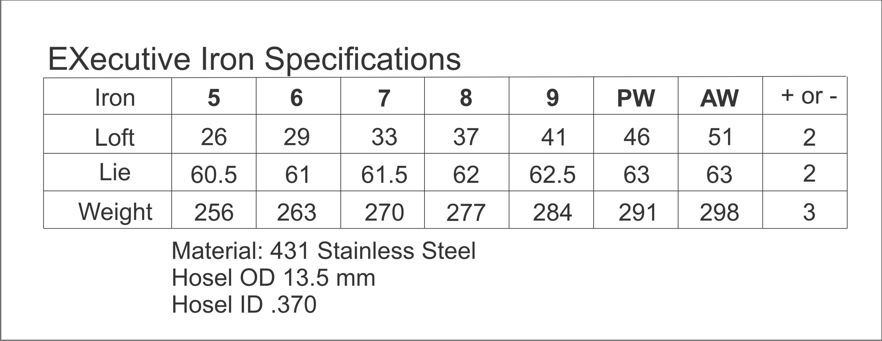
Classic Design with Game Improvement features to benefit any level of golfer. Finding the sweet spot won’t be difficult with this perimeter weighted deep cavity back design and performance enhancing features. Slightly off center hits will get more distance and have less dispersion because of the perimeter weighting that creates a higher MOI. The EXecutive iron is forgiving on mishits and stronger lofted for more distance but with a low center of gravity to get the needed launch angle.
The EXecutive irons are great for good to average golfer to to higher handicappers
Available in Right Hand 5 iron thru AW. Extra 7 irons will be available for demo or test heads.
Customer comments:
Feel great, as good as my forged set...
Very solid feeling irons... I'd recommend them to anyone
Distances are good and EX graphite shafts are great
I'm a clubmaker and after I tried them, I'm bagging them now. Wedges really spin
Features:
* All clubs are custom fitted and assembled and may take from 2 to 4 weeks before they ship. Some items might have to be ordered. Please allow at least 4 weeks before you inquire about delivery.
Custom clubs are assembled to the highest AGCP standards of quality. Shafts are optimized for more consistent center face contact and lengths and weights are carefully designed for your swing as described when you order.
Blade and cavity-back irons differ in design, performance, and target audience. Here's a concise comparison based on how they impact a golfer's game:
### **1. Design**
- **Blade Irons:**
- Compact, traditional design with a thin topline and minimal offset.
- Solid, uniform clubhead with no cavity; weight is evenly distributed across the clubface.
- Often called "muscle-back" due to the thicker mass behind the center of the clubface.
- **Cavity-Back Irons:**
- Feature a hollowed-out "cavity" on the back of the clubhead, redistributing weight to the perimeter (perimeter weighting).
- Larger clubhead, thicker topline, and more offset compared to blades.
- Designed to enhance forgiveness and playability.
### **2. Forgiveness**
- **Blade Irons:**
- Low forgiveness; small sweet spot means off-center hits lose significant distance and accuracy.
- Requires precise ball-striking, making them less ideal for inconsistent or high-handicap golfers.
- **Cavity-Back Irons:**
- High forgiveness due to perimeter weighting, which increases the moment of inertia (MOI) and reduces clubhead twisting on mishits.
- Larger sweet spot makes them more forgiving, ideal for beginners, mid-handicappers, and even some low-handicappers.
### **3. Workability**
- **Blade Irons:**
- Highly workable; their compact design and centered weight allow skilled golfers to shape shots (draws, fades, etc.) with precision.
- Preferred by low-handicap players who prioritize control and shot-making over forgiveness.
- **Cavity-Back Irons:**
- Less workable than blades due to perimeter weighting, which stabilizes the clubhead and limits shot-shaping control.
- Still offer some workability, especially in modern game-improvement models, but not to the same degree as blades.
### **4. Distance and Launch**
- **Blade Irons:**
- Typically produce lower ball flight and slightly less distance due to a higher center of gravity (CG).
- Suited for players with high swing speeds who can generate their own distance and prefer a penetrating trajectory.
- **Cavity-Back Irons:**
- Promote higher launch and potentially more distance due to a lower CG and larger sweet spot.
- Often incorporate stronger lofts in modern designs, boosting distance, especially for players with slower swing speeds.
### **5. Feel and Feedback**
- **Blade Irons:**
- Provide exceptional feedback; solid strikes feel soft and pure, while mishits are more noticeable (vibration or harshness).
- Preferred by skilled players who value the tactile feedback for refining their swing.
- **Cavity-Back Irons:**
- Softer, less distinct feel due to weight distribution and larger clubhead, which dampens feedback on mishits.
- Still offer good feel in higher-end models, but not as crisp as blades.
### **6. Target Audience**
- **Blade Irons:**
- Best for low-handicap golfers (scratch to single-digit handicaps) with consistent ball-striking and a focus on shot-shaping.
- Common among professionals and advanced amateurs who prioritize control over forgiveness.
- **Cavity-Back Irons:**
- Suited for mid-to-high handicappers, beginners, or players seeking consistency and ease of use.
- Also used by some low-handicappers who prefer forgiveness without sacrificing too much workability (e.g., players' cavity-back irons).
### **7. Aesthetics**
- **Blade Irons:**
- Sleek, classic look with a compact head and thin topline, often preferred by purists for their traditional appearance.
- **Cavity-Back Irons:**
- Bulkier appearance with a thicker topline and more offset, which can inspire confidence at address for some players but may look less refined to others.
### **Summary**
- **Choose Blade Irons** if you're a skilled golfer who prioritizes workability, feedback, and precision, and you can consistently hit the center of the clubface. They demand skill but reward control.
- **Choose Cavity-Back Irons** if you're a beginner, mid-to-high handicapper, or a player seeking forgiveness, higher launch, and consistency on off-center hits. They’re easier to hit and suit a broader range of golfers.
Modern advancements have blurred the lines slightly, with some cavity-back irons (e.g., players’ distance irons) offering a blend of forgiveness and workability, but the core distinctions remain. Your choice depends on your skill level, swing consistency, and playing goals.


 Blade and cavity-back irons differ in design, performance, and target audience. Here's a concise comparison based on how they impact a golfer's game: